A City in Mind: Former Cascadura Drummer Thiago Trad Launches Solo Project with Moscote, an Instrumental Journey Led by Piano
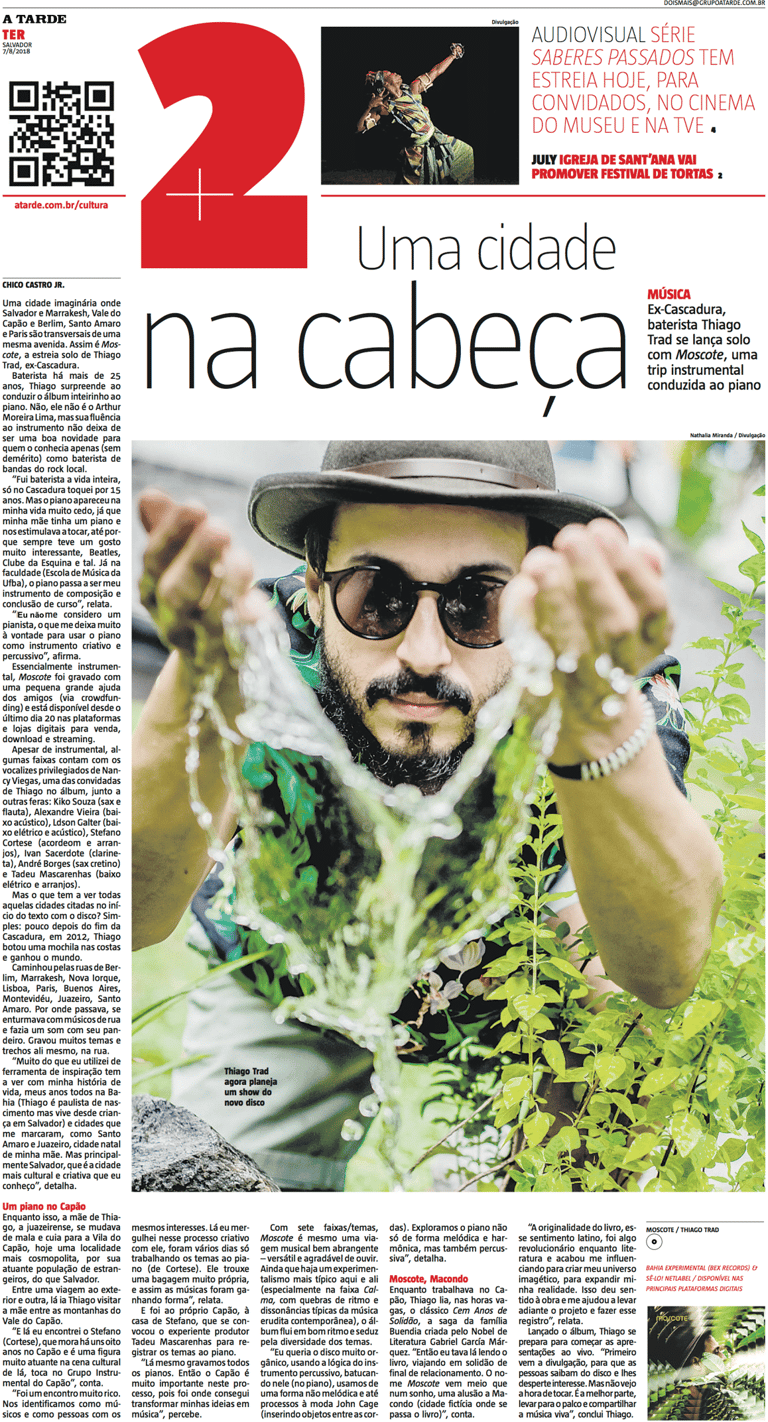
An imaginary city where Salvador and Marrakech, Vale do Capão and Berlin, Santo Amaro and Paris intersect on the same avenue. This is Moscote, the solo debut of Thiago Trad, former Cascadura drummer.
7/8/20183 min read
(Chico Castro Jr. – Jornal A Tarde, 08/07/2018)
Having played drums for over 25 years, Thiago surprises by leading the entire album on piano. No, he’s not Arthur Moreira Lima, but his fluency on the instrument is a delightful revelation for those who knew him only (without any disrespect) as a drummer in local rock bands. "I’ve been a drummer my whole life, and I played in Cascadura for 15 years. But the piano came into my life very early since my mother had a piano and encouraged us to play, particularly because she had a very interesting taste in music, like the Beatles and Clube da Esquina. In college (School of Music at UFBA), the piano became my instrument for composition and for completing my degree," he shares. "So I consider myself a pianist, which makes me very comfortable using the piano as a creative and percussive instrument," he states.
Essentially instrumental, Moscote was recorded with a little big help from friends (via crowdfunding) and has been available since the 20th on digital platforms and in stores for sale, download, and streaming. Despite being instrumental, some tracks feature the privileged vocalizations of Nancy Viegas, one of Thiago’s guests on the album, alongside other artists: Kiko Souza (sax and flute), Alexandre Vieira (acoustic bass), Ldson Galter (electric and acoustic bass), Stefano Cortese (accordion and arrangements), Ivan Sacerdote (clarinet), André Borges (sax), and Tadeu Mascarenhas (electric bass and arrangements). But what do all those cities mentioned at the beginning of the text have to do with the album? Simple: shortly after the end of Cascadura in 2012, Thiago threw a backpack on his back and set out to explore the world.
He walked through the streets of Berlin, Marrakech, New York, Lisbon, Paris, Buenos Aires, Montevideo, Juazeiro, and Santo Amaro. Wherever he went, he connected with street musicians and made music with his pandeiro. He recorded many themes and snippets right there on the street. “Much of what I used as a source of inspiration relates to my life story, my many years in Bahia (Thiago was born in São Paulo but has lived in Salvador since childhood) and the cities that marked me, such as Santo Amaro and Juazeiro, my mother's hometown. But mainly Salvador, which is the most cultural and creative city I know,” he explains.
A Piano in Capão
Meanwhile, Thiago's mother, from Juazeiro, was moving with all her belongings to the Vila do Capão, now a more cosmopolitan location due to its active foreign population than Salvador.
Between one trip abroad and another, Thiago would visit his mother among the mountains of Vale do Capão. "And there I met Stefano (Cortese), who has lived in Capão for about eight years and is a very active figure in the local cultural scene; he plays in the Instrumental Group of Capão," he says. "It was a very rich encounter. We identified as musicians and as people with the same interests. There, I immersed myself in this creative process with him; we spent several days just working on the themes at the piano (of Cortese). He brought a very unique background, and thus the songs began to take shape," he reports.
It was in Capão, at Stefano's house, that experienced producer Tadeu Mascarenhas was called to record the themes on piano. "We recorded all the pianos right there. So, Capão is very important in this process, as it was where I managed to transform my ideas into music," he realizes. With seven tracks/themes, Moscote is indeed a broad musical journey – versatile and pleasant to listen to. Although there is a more typical experimentalism here and there (especially in the track "Calma," with rhythmic breaks and dissonances typical of contemporary classical music), the album flows at a good pace and captivates with its diversity of themes. "I wanted the album to be very organic, using the logic of a percussion instrument, tapping on it (the piano). We used it in a non-melodic way and even applied techniques like John Cage (inserting objects between the strings). We explored the piano not only melodically and harmonically but also percussively," he details.